
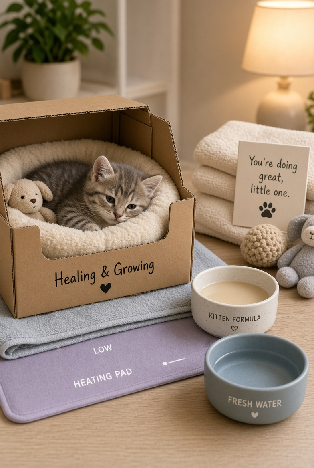
How to care for a rescued kitten starts with one simple idea: give the kitten safety, warmth, food, clean water, gentle care, and time.
Finding a tiny kitten can feel exciting and scary at the same time. One minute, you may be walking outside. The next minute, you may be holding a small animal that needs your help.
However, do not panic.
First, look at the kitten carefully. Is the kitten warm and active? Is it crying all the time? Does it look thin, dirty, injured, or sick? Also, check whether the mother cat may be nearby.
The ASPCA explains that a mother cat may leave her kittens for a while to find food. Therefore, a kitten that looks alone is not always abandoned. If the kittens look clean, healthy, plump, and quiet, watching from a safe distance may be better than immediately taking them away.
On the other hand, a cold, weak, injured, very thin, or constantly crying kitten may need urgent help.
This guide explains how to care for a rescued kitten from the first few hours through feeding, litter training, socialization, veterinary care, and the move into a permanent home.
Important: This guide gives general pet-care information. A rescued kitten can become seriously ill very quickly, especially if it is very young. Always contact a veterinarian or local animal rescue when the kitten is sick, injured, very young, or not eating.
How to Care for a Rescued Kitten Begins With a Careful Check
Before you bring the kitten into your home, take a quiet moment to look at its condition.
Check these simple things:
- Is the kitten breathing normally?
- Is the kitten warm?
- Can it stand or walk?
- Does it react when you touch it gently?
- Are the eyes open?
- Does the kitten have diarrhea?
- Does the nose have thick discharge?
- Are there wounds?
- Are fleas covering the body?
- Does the kitten seem extremely weak?
- Is it crying nonstop?
If you see serious injury, trouble breathing, severe weakness, bleeding, or another emergency sign, contact a veterinarian immediately.
Also, remember that very young kittens need special care. Newborn kittens cannot manage their own body temperature well. They also depend heavily on milk and regular care.
Look for the Mother Before Taking a Healthy Kitten Away
One of the most important parts of how to care for a rescued kitten is knowing when not to rescue it immediately.
If you find several kittens outside, look around for the mother.
Do not stand directly over the kittens for hours. Instead, move far enough away that the mother feels safe returning.
The ASPCA recommends watching for the mother because she may be nearby, hiding, or searching for food.
If the mother returns and the area is safe, keeping the family together may give the kittens their best start.
If the area is dangerous, move the kittens to a nearby safe location where the mother can still find them.
Learn the Kitten’s Age Before Choosing a Care Plan
Age changes almost everything.
A kitten that is one week old needs very different care from a kitten that is eight weeks old.
Here is a simple guide:
| Approximate age | Common signs | Main care |
| Under 1 week | Eyes closed, tiny body | Warmth and milk replacement if orphaned |
| 1–2 weeks | Eyes beginning to open | Frequent feeding and warmth |
| 2–3 weeks | More movement | Feeding, warmth, gentle handling |
| 3–4 weeks | Walking more | Begin learning to eat from a dish |
| 4–5 weeks | Playful, better balance | Wet kitten food and socialization |
| 5–8 weeks | Runs and plays | Kitten food, litter learning, social skills |
| 8+ weeks | More independent | Routine vet care, play, training, adoption planning |
These are general signs, not exact rules.
For example, a weak kitten may behave younger than its actual age. Therefore, a veterinarian can help estimate age more accurately.
How to Care for a Rescued Kitten During the First Hour
The first hour matters.
First, place the kitten somewhere quiet.
Then check its body temperature by touch. If the kitten feels cold, warming it becomes a priority.
Do not rush to feed a very cold kitten.
A chilled newborn may not digest food properly. Instead, seek veterinary or experienced rescue guidance while warming the kitten safely.
Use a soft towel and a safe heat source. Leave enough room for the kitten to move away from the warmth.
Never place a kitten directly against a very hot heating pad.
A wrapped warm-water bottle can also help, but check the temperature often.
The goal is gentle warmth, not heat.
Create a Small Safe Room
A rescued kitten does not need your entire home on day one.
In fact, a small room can make the kitten feel safer.
Choose a quiet space with:
- A soft bed
- Food and water
- A litter box
- Safe toys
- A hiding area
- Easy-to-clean flooring
- No loose wires
- No open windows
- No dangerous plants
- No access to larger pets
A bathroom, spare room, or quiet corner can work well.
However, make sure the room has good airflow and a comfortable temperature.
A small space also makes it easier for you to monitor eating, drinking, poop, pee, and behavior.
How to Care for a Rescued Kitten With the Right Warmth
Warmth is especially important for newborn and very young kittens.
Mother cats normally provide warmth by staying close to their babies. When the mother is missing, you must create a safe replacement.
Use bedding that stays dry.
Change wet bedding quickly.
Keep the kitten away from cold floors and drafts.
At the same time, avoid overheating.
A useful setup has a warm area and a cooler area. This lets the kitten move away from the heat when needed.
For newborn or orphaned kittens, professional guidance is especially useful because temperature needs change with age.
Choose the Right Food for the Kitten’s Age
Food is another major part of how to care for a rescued kitten.
Never assume cow’s milk is a good replacement for mother cat milk.
The ASPCA recommends commercial kitten milk replacer when an orphaned kitten needs replacement milk and advises contacting a veterinarian for feeding and product guidance.
Very young kittens usually need kitten milk replacer.
Older kittens can gradually move toward wet and dry kitten food.
Look for food made specifically for kittens.
Kittens grow quickly, so they need food designed for growth.
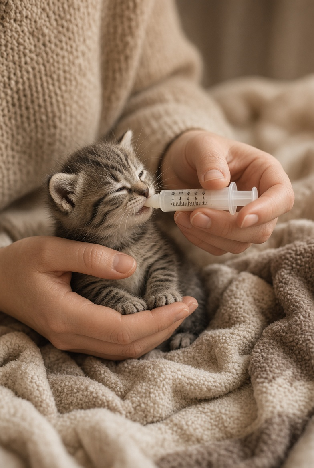
Bottle Feeding Needs Patience
Bottle feeding can look easy in videos, but it requires care.
Hold the kitten in a natural belly-down position.
Never feed a kitten while it lies on its back like a human baby.
Let the kitten suck at its own pace.
Do not force liquid into its mouth.
Too much liquid or poor feeding technique can cause serious breathing problems.
If the kitten cannot latch, keeps coughing, becomes weak, or refuses food, contact a veterinarian or experienced kitten rescue worker.
The ASPCA has documented that orphaned kittens may require frequent hand feeding and close monitoring, especially when they are under four weeks old.
Make a Feeding Schedule You Can Actually Follow
Young kittens may need frequent meals.
Therefore, create a written schedule.
Record:
- Feeding time
- Amount offered
- Amount consumed
- Weight
- Urination
- Bowel movements
- Medicine given by a veterinarian
- Any unusual behavior
A simple notebook can save you from guessing.
For very young kittens, feeding may need to happen during the night as well.
The ASPCA describes orphaned kittens under four weeks as needing around-the-clock care, including regular feeding, warmth, and careful monitoring.
Weigh the Kitten Regularly
A kitchen scale can become one of your best rescue tools.
Use a small digital scale that measures in grams.
Weigh the kitten at the same time each day when possible.
Write down the result.
A kitten that fails to gain weight deserves attention.
A sudden weight drop can also be a warning sign.
Do not judge growth only by looking at the kitten. A daily weight record gives you useful information to share with your veterinarian.
Help Very Young Kittens With Bathroom Needs
Very young kittens may need help urinating and passing stool.
Normally, their mother stimulates them.
If you are caring for an orphaned kitten, ask your veterinarian or experienced rescue group to show you the correct technique.
Do not rub the area roughly.
Use gentle handling.
Once kittens become old enough, they can start learning to use a litter box on their own.
This stage changes quickly, so watch the kitten closely.
How to Care for a Rescued Kitten During Weaning
Weaning is the bridge from milk to kitten food.
It should happen gradually.
The ASPCA explains that kittens can begin moving toward solid food by learning to lap milk replacer from a shallow dish and then eating a soft mixture of kitten food and milk replacer.
Start slowly.
A kitten may step into the food.
It may play with the food.
It may walk away.
That is normal.
Clean the kitten gently after messy meals.
With patience, most kittens learn.
Introduce Kitten Food Without a Sudden Change
When the kitten begins eating on its own, choose complete kitten food.
You can offer wet kitten food in small portions.
Some kittens also learn to eat dry kitten food.
Always provide fresh water once the kitten is old enough to drink it independently.
The ASPCA notes that kittens should gradually move from milk replacer toward kitten food during weaning.
Avoid making sudden diet changes whenever possible.
A sudden change can upset a young kitten’s stomach.
Set Up the First Litter Box
A kitten needs an easy-to-reach litter box.
Choose a low-sided box for a small kitten.
Place it away from food and water.
After meals and naps, gently place the kitten in the box.
Do not punish accidents.
Instead, clean the area well and try again.
Kittens learn through repetition.
As the kitten grows, you can move to a larger box.
Pick Safe Litter for a Young Kitten
Not every litter is ideal for every kitten.
Young kittens may play with litter and sometimes put things in their mouths.
Therefore, ask your veterinarian or rescue organization which litter type fits the kitten’s age and health.
Keep the box clean.
Scoop waste often.
A dirty box can discourage use.
Also, avoid strong fragrances around a young kitten. Cats have sensitive noses, and a clean, simple environment is usually easier for them.
How to Care for a Rescued Kitten With Good Hygiene
Rescued kittens can arrive dirty.
However, avoid giving a full bath unless it is needed and you know the kitten is warm enough.
A very young kitten can become chilled quickly.
For small messes, use a warm, damp cloth.
Gently wipe the dirty area.
Then dry the kitten completely.
If the kitten has severe dirt, diarrhea, fleas, or skin problems, ask a veterinarian for help.
Never use random human shampoo or household cleaning products on the kitten.
Handle Fleas With Extra Care
Fleas are common in rescued kittens.
However, flea treatment needs special care because some flea products are unsafe for young kittens.
Do not grab a random flea medicine from a shelf.
Check the kitten’s age and weight first.
Then ask a veterinarian which treatment is safe.
A flea comb may also help remove adult fleas, but heavy flea loads can cause serious problems in tiny kittens.
If the kitten looks pale, weak, or extremely tired, seek veterinary help quickly.
Schedule a Veterinary Examination
A vet visit is one of the most important steps in how to care for a rescued kitten.
Even when a kitten looks healthy, it may have worms, fleas, infection, dehydration, or another problem that you cannot see.
A veterinarian can check:
- Weight
- Hydration
- Eyes
- Ears
- Mouth
- Heart
- Lungs
- Skin
- Parasites
- Overall growth
The vet can also build a vaccine and parasite-control plan based on age, weight, health, and local risks.
The ASPCA recommends veterinary care as part of the process of preparing rescued kittens for healthy adoption.
Keep the Rescued Kitten Separate From Other Pets
If you already have cats or dogs, do not introduce them immediately.
Keep the rescued kitten in its own room.
This gives the kitten time to settle.
It also reduces the chance of spreading an illness to your other pets.
Wash your hands after handling the rescued kitten, especially before handling another animal.
Your veterinarian can tell you when a gradual introduction is appropriate.
Watch for Signs of Illness
Knowing how to care for a rescued kitten also means knowing when home care is not enough.
Watch for:
- Refusing food
- Extreme sleepiness
- Trouble breathing
- Repeated vomiting
- Severe diarrhea
- Blood in stool
- Swollen belly
- Eye discharge
- Thick nasal discharge
- Pale gums
- Severe weakness
- Dehydration
- Sudden weight loss
- Seizures
- Major injury
Very young kittens can become sick quickly.
Therefore, do not wait several days if something seems seriously wrong.
Call a veterinarian.
How to Care for a Rescued Kitten With Gentle Socialization
Food keeps a kitten alive.
However, gentle social contact helps shape future behavior.
Sit near the kitten.
Speak softly.
Let the kitten approach you.
Use gentle play.
Offer safe toys.
Avoid grabbing or chasing a frightened kitten.
A kitten that hides today may become friendly tomorrow.
The ASPCA has shared rescue stories showing that frightened kittens can gradually learn to trust people with patient care and positive experiences.
Let a Shy Kitten Set the Pace
Do not force friendship.
Instead, make yourself predictable.
Sit on the floor.
Read a book.
Talk softly.
Offer a small treat when appropriate.
Use a toy to encourage play.
Over time, the kitten may come closer.
This process can take days or weeks.
That is okay.
Trust is built through repeated safe experiences.
Use Play to Build Confidence
Play is more than entertainment.
It helps a kitten learn how to move, chase, jump, and interact.
Use kitten-safe toys such as:
- Soft balls
- Wand toys used with supervision
- Small cat toys
- Crinkle toys
- Simple cardboard boxes
Never leave string, ribbon, or similar items with a kitten without supervision.
A kitten can swallow these objects, which can become a medical emergency.
Teach Gentle Human Interaction
Everyone in the household should learn how to handle the kitten.
Children should sit down while holding a small kitten.
They should support the kitten’s body.
They should never squeeze, pull the tail, or chase the animal.
Teach children that a sleeping kitten should be left alone.
Also, teach them that cats communicate through body language.
A kitten that hisses or hides may be saying, “I need space.”
Respect that message.
How to Care for a Rescued Kitten Around Children
A rescued kitten can become a wonderful family companion.
Still, the relationship should grow slowly.
Always supervise young children.
Show children how to touch the kitten gently.
Give the kitten a hiding space that children cannot enter.
This creates a safe escape when the kitten wants quiet time.
As the kitten becomes comfortable, positive interactions can increase.
Protect the Kitten From Common Home Dangers
A kitten explores everything.
Therefore, kitten-proof your home.
Check for:
- Electrical cords
- Open windows
- Small objects
- Plastic bags
- Toxic plants
- Cleaning products
- Open toilets
- Hot cooking surfaces
- Unsecured cabinets
- Gaps behind appliances
- Loose strings
- Small toys
Also, keep medicines out of reach.
A curious kitten can turn a normal household object into a danger.
Build a Simple Daily Routine
Cats like predictable routines.
A rescued kitten may feel less stressed when meals, play, sleep, and cleaning happen around similar times.
A simple routine might look like this:
Morning: Food, water, litter check, gentle play.
Midday: Rest, food according to age, litter check.
Afternoon: Play and social time.
Evening: Food, gentle handling, litter cleaning.
Night: Quiet, safe sleeping space.
Young kittens may need more frequent feeding than this simple example.
Always follow the feeding plan given by your veterinarian for a very young kitten.
How to Care for a Rescued Kitten When You Work
Many people worry that they cannot rescue a kitten because they work during the day.
The answer depends on the kitten’s age.
A very young orphaned kitten may require frequent care and may not be suitable for someone who cannot provide that schedule.
An older, independent kitten may be easier to care for.
If you work long hours, contact a local rescue group for foster support.
The ASPCA notes that neonatal kittens can require round-the-clock attention, while foster care can provide the regular support they need.
Advantages of Rescuing a Kitten
There are many rewards.
You give an animal a second chance
A rescued kitten may have faced hunger, danger, or abandonment.
Your care can change its life.
You can build a strong bond
Hand-raised kittens often become very attached to their caregivers.
You learn valuable skills
You may learn about feeding, animal behavior, grooming, and basic pet health.
You help reduce animal suffering
Even one rescued kitten matters.
You may gain a wonderful companion
That tiny frightened animal may eventually become a playful and loving adult cat.
Disadvantages and Challenges of Kitten Rescue
Rescue work also has difficult parts.
It takes time
Young kittens can require frequent care.
Veterinary costs can be high
Illness, parasites, vaccines, and other care can add up.
Sleep may be interrupted
Very young orphaned kittens can need care during the night.
Emotional stress can happen
A sick kitten can be frightening.
Other pets may need separation
You may need to create a separate space for several weeks or until your veterinarian approves introductions.
Therefore, rescue is rewarding, but it should not be treated as an easy task.
Real-Life Example: Three Kittens Get a Second Chance
A real ASPCA case shows why quick, careful care matters.
In 2017, three kittens were rescued after being found in a tied garbage bag. The kittens were only about a month old and needed medical attention. ASPCA staff treated dehydration and bottle-fed them before moving them into the kitten nursery. They were then fed, bathed, groomed, and monitored as they recovered.
The story shows an important lesson.
A tiny kitten may look helpless, but proper care can make a huge difference.
It also shows why rescuers should work with veterinary teams when a kitten is weak or sick.
Case Study: A Frightened Kitten Learns to Trust
Another ASPCA story follows a young stray kitten named Parker.
Parker was healthy after veterinary evaluation, but he was very fearful of people. His lack of experience with humans made him shy. With time and care, he learned to trust people and eventually found a home.
This case teaches us not to judge a kitten by its first reaction.
A kitten that hides is not necessarily an unfriendly kitten.
Sometimes it simply needs time.
Case Study: A Kitten Recovers After a Difficult Start
In a 2026 ASPCA case, an eight-month-old kitten named Router had entered the ASPCA Kitten Nursery at about four weeks old and later found an adoptive home after facing medical challenges.
This kind of story gives new rescuers hope.
However, it also shows why veterinary care matters.
A good outcome often requires teamwork between rescuers, foster caregivers, veterinary professionals, and adopters.
Expert Advice for New Kitten Rescuers
The best advice is simple: do not try to do everything alone.
Contact a veterinarian.
Contact a local shelter.
Contact an experienced rescue group.
Ask questions when you are unsure.
Keep written records.
Follow professional feeding instructions.
Do not give medicine without proper guidance.
Also, remember that the mother cat may be the best caregiver for very young kittens when she is healthy and present. ASPCA guidance repeatedly stresses checking whether the mother is nearby before separating healthy kittens from her.
How to Care for a Rescued Kitten on a Small Budget
Rescue does not have to mean buying everything at once.
Start with the basics:
- Kitten food or veterinarian-recommended milk replacer
- Food bowl
- Water bowl
- Litter box
- Litter
- Towels
- Safe bed
- Simple toys
- Carrier
A cardboard box can become a temporary hiding place.
Old clean towels can become bedding.
However, do not save money by skipping needed veterinary care.
Medical care should remain a priority.
How to Care for a Rescued Kitten During the First Week
The first week should focus on stability.
Keep the kitten in a quiet area.
Feed according to age and veterinary advice.
Monitor weight.
Watch the litter box.
Look for signs of illness.
Schedule veterinary care.
Start gentle socialization.
Avoid overwhelming the kitten with visitors.
The goal is not to make the kitten perfect in seven days.
The goal is to help the kitten feel safe.
How to Care for a Rescued Kitten During the First Month
By the first month, many kittens become much more active.
They may run, climb, play, eat independently, and use the litter box.
Continue veterinary care.
Continue socialization.
Offer safe play.
Provide age-appropriate kitten food.
Keep dangerous items away.
If the kitten has not already received professional guidance about vaccines, parasite control, microchipping, and spay/neuter timing, discuss these topics with your veterinarian.
Prepare for Vaccines and Preventive Care
Vaccines help protect kittens from serious infectious diseases.
However, vaccine timing depends on age, health, previous care, and local veterinary recommendations.
Do not copy another kitten’s vaccine schedule.
Instead, ask your veterinarian to create a plan.
The same approach applies to deworming and parasite prevention.
Your kitten’s weight and health matter.
Consider Microchipping and Identification
A rescued kitten should have a clear identification plan.
Ask your veterinarian about microchipping at the appropriate age.
Also, keep updated contact information connected to the chip.
If the kitten later escapes, identification can increase the chance of a safe reunion.
A collar and identification tag may also be appropriate, depending on the kitten and your veterinarian’s advice.
Plan for Spay or Neuter Care
If you are keeping the kitten, discuss spay or neuter timing with your veterinarian.
If you are fostering the kitten, ask the rescue group about its policy.
Preventing unwanted litters helps reduce the number of homeless cats.
The ASPCA includes spay/neuter as part of preparing rescued kittens for adoption.
How to Care for a Rescued Kitten Before Adoption
If you plan to find another home for the kitten, do not rush.
First, make sure the kitten is healthy enough for adoption.
Keep veterinary records.
Write down the kitten’s estimated age.
Record vaccination information.
Share feeding details.
Explain the kitten’s personality.
Tell the adopter about any known medical needs.
A good adoption match is better than a quick adoption.
Build a Kitten Care Chart
Use this chart to keep your daily plan simple.
| Care area | What to check | Why it matters |
| Food | Appetite and feeding schedule | Supports growth |
| Water | Fresh water when age-appropriate | Supports hydration |
| Weight | Daily or regular weight checks | Shows growth trends |
| Litter | Pee and poop | Helps track health |
| Warmth | Body and bedding | Young kittens can chill |
| Eyes | Clear or unusual discharge | Helps spot illness |
| Nose | Normal or heavy discharge | Helps spot respiratory issues |
| Energy | Playful or unusually weak | Shows general condition |
| Skin | Fleas, wounds, irritation | Helps catch problems |
| Behavior | Calm, scared, aggressive, playful | Helps guide socialization |
| Vet care | Appointments and treatments | Supports healthy development |
Keep this chart on your phone or beside the kitten’s care area.
Common Mistakes New Rescuers Should Avoid
New rescuers often make mistakes because they want to help quickly.
Here are common problems to avoid.
Mistake one: Taking healthy kittens away without checking for their mother.
Mistake two: Feeding cow’s milk to an orphaned kitten.
Mistake three: Feeding a cold kitten without getting proper guidance.
Mistake four: Giving human medicine.
Mistake five: Using unsafe flea products.
Mistake six: Introducing the kitten to other pets too quickly.
Mistake seven: Giving the kitten too much freedom before the home is safe.
Mistake eight: Punishing litter accidents.
Mistake nine: Forcing a frightened kitten to interact.
Mistake ten: Waiting too long when a kitten looks seriously ill.
Avoiding these mistakes makes rescue much safer.
FAQs About How to Care for a Rescued Kitten
1: How to care for a rescued kitten on the first day?
Start by checking whether the kitten needs emergency veterinary help. Then provide a quiet, safe, warm space and age-appropriate food. If the kitten is very young or orphaned, contact a veterinarian or rescue group for a feeding plan.
2: How do I know if a kitten has been abandoned?
You cannot always tell immediately. The mother may be nearby looking for food. Watch from a safe distance when possible. If the kittens are clean, warm, plump, and quiet, their mother may still be caring for them.
3: Can I give a rescued kitten cow’s milk?
It is generally not a suitable replacement for mother cat milk. The ASPCA recommends commercial kitten milk replacer for orphaned kittens when replacement feeding is needed.
4: What should a rescued kitten eat?
It depends on age. Very young orphaned kittens may need kitten milk replacer, while older kittens can move toward wet and dry kitten food. Ask your veterinarian for an age-appropriate feeding plan.
5: How often should I feed a newborn kitten?
Very young orphaned kittens may need frequent feeding, including overnight care. Because feeding needs depend on age, weight, and health, get a specific schedule from a veterinarian or experienced kitten rescue group.
6: How do I keep a rescued kitten warm?
Use soft bedding and a safe, gentle heat source. Make sure the kitten can move away from the heat. Never use extreme heat or place a kitten directly on a hot heating pad.
7: When should a rescued kitten see a vet?
As soon as practical, especially if the kitten is very young, weak, injured, underweight, not eating, or showing signs of illness.
8: How do I know if my kitten is sick?
Watch for poor appetite, severe weakness, trouble breathing, repeated vomiting, serious diarrhea, dehydration, eye or nose discharge, pale gums, or sudden weight loss. Contact a veterinarian if you notice concerning symptoms.
9: Can I bathe a rescued kitten?
Only when necessary and when you can keep the kitten warm afterward. Very young kittens can become chilled. For simple dirt, a warm damp cloth may be enough.
10: How do I remove fleas from a rescued kitten?
Ask a veterinarian which flea treatment is safe for the kitten’s age and weight. Do not use a random flea medicine because some products can be dangerous for young kittens.
11: When can a rescued kitten use a litter box?
Kittens begin learning as they become more independent. A low-sided box can help a young kitten reach it easily. Older kittens can usually learn quickly with gentle guidance.
12: Why does my rescued kitten hide?
The kitten may feel scared or overwhelmed. Give it a quiet hiding place and avoid forcing contact. Sit nearby and speak softly. Trust can take time.
13: How do I make my rescued kitten trust me?
Use patience. Offer food, gentle play, quiet conversation, and short positive interactions. Let the kitten choose when to come closer.
14: Should I let my rescued kitten sleep with me?
For a tiny kitten, a separate safe sleeping area is often safer because you could accidentally roll onto the kitten. A secure bed or nesting area is a better choice.
15: Can a rescued kitten live with my other cat?
Yes, many cats eventually live happily together. However, introductions should be slow, and the rescued kitten should first be separated while you address health concerns and follow veterinary advice.
16: How long does it take for a rescued kitten to become friendly?
There is no single answer. Some kittens become comfortable within days. Others need weeks or longer. Age, past experiences, personality, and social contact all affect the process.
17: What if my rescued kitten will not eat?
Do not ignore a kitten that refuses food, especially if it is very young. Contact a veterinarian promptly because young kittens can become weak quickly.
18: Should I give my rescued kitten medicine at home?
Do not give human medicine or random pet medicine without veterinary guidance. A kitten’s small size makes dosing mistakes especially dangerous.
19: When should a rescued kitten get vaccines?
Your veterinarian should create the schedule based on the kitten’s age, health, previous history, and local risks.
20: How can I find a good home for a rescued kitten?
First, make sure the kitten is healthy and has received appropriate veterinary care. Then work with a trusted rescue organization or carefully screen potential adopters. Keep the kitten’s medical and feeding records.
Final Checklist for How to Care for a Rescued Kitten
Before you finish the first stage of how to care for a rescued kitten, check this list:
- I checked whether the mother cat may be nearby.
- I checked the kitten for injury.
- I created a warm and safe space.
- I learned the kitten’s approximate age.
- I chose age-appropriate food.
- I avoided cow’s milk.
- I made a feeding plan.
- I recorded the kitten’s weight.
- I prepared a litter box.
- I kept the kitten away from unsafe areas.
- I separated the kitten from other pets at first.
- I contacted a veterinarian.
- I watched for signs of illness.
- I started gentle socialization.
- I kitten-proofed the home.
- I planned future vaccines and parasite care.
- I discussed microchipping with my vet.
- I discussed spay/neuter timing.
- I kept veterinary records.
- I prepared a long-term home plan.
External Resources for Kitten Care
For trustworthy information, use established animal welfare and veterinary resources rather than random social media posts.
- ASPCA – I Found Kittens Outside. What Do I Do?
Excellent resource for explaining what to do when someone finds kittens outdoors, including determining whether the mother cat is nearby. ASPCA: I Found Kittens Outside—What Do I Do? - ASPCA – Cat Nutrition Tips
Useful for information about kitten nutrition, feeding, weaning, and appropriate food. ASPCA: Cat Nutrition Tips - ASPCA – Kitten Nursery
A helpful resource for readers caring for very young or orphaned kittens and learning about neonatal kitten care. ASPCA: Kitten Nursery - Cornell Feline Health Center – Feeding Your Cat
Cornell’s veterinary school explains feline nutrition, complete diets, life-stage nutrition, and why proper food matters. Cornell Feline Health Center: Feeding Your Cat - Cornell Feline Health Center – How Often Should You Feed Your Cat?
This is especially useful for your sections about kitten feeding schedules because Cornell explains why kittens need more frequent meals than adult cats. Cornell Feline Health Center: How Often Should You Feed Your Cat? - Cornell Feline Health Center – Choosing and Caring for Your New Cat
A good general resource covering nutrition, scratching, weight, behavior, and caring for a new cat. Cornell Feline Health Center: Choosing and Caring for Your New Cat - Cornell Feline Health Center – Feline Health Topics
A broad veterinary resource covering feline health problems, hydration, respiratory infections, common hazards, nutrition, and other important topics. Cornell Feline Health Center: Feline Health Topics
Conclusion
Learning how to care for a rescued kitten can feel overwhelming at first. However, you do not need to know everything on day one.
Start with the basics.
Keep the kitten safe.
Keep it warm.
Provide the correct food.
Watch its weight.
Keep the litter area clean.
Give it quiet time.
Arrange veterinary care.
Then, slowly build trust.
Most importantly, remember that every kitten is different. A newborn orphan may need round-the-clock support. An older stray may mainly need food, medical care, safety, and patience.
Also, do not forget the mother cat. If healthy kittens are outside and the mother may be nearby, stopping to observe can sometimes be the kindest choice. The ASPCA emphasizes that mother cats provide the best care for their young when they are present and able to care for them.
Finally, rescuing a kitten is more than giving it a meal. You are helping a small animal learn that the world can be safe.
With good food, proper veterinary care, gentle handling, and plenty of patience, that frightened little kitten can grow into a healthy, confident companion.
And that is the heart of how to care for a rescued kitten: protect first, feed wisely, watch closely, ask for help when needed, and let trust grow one small step at a time.